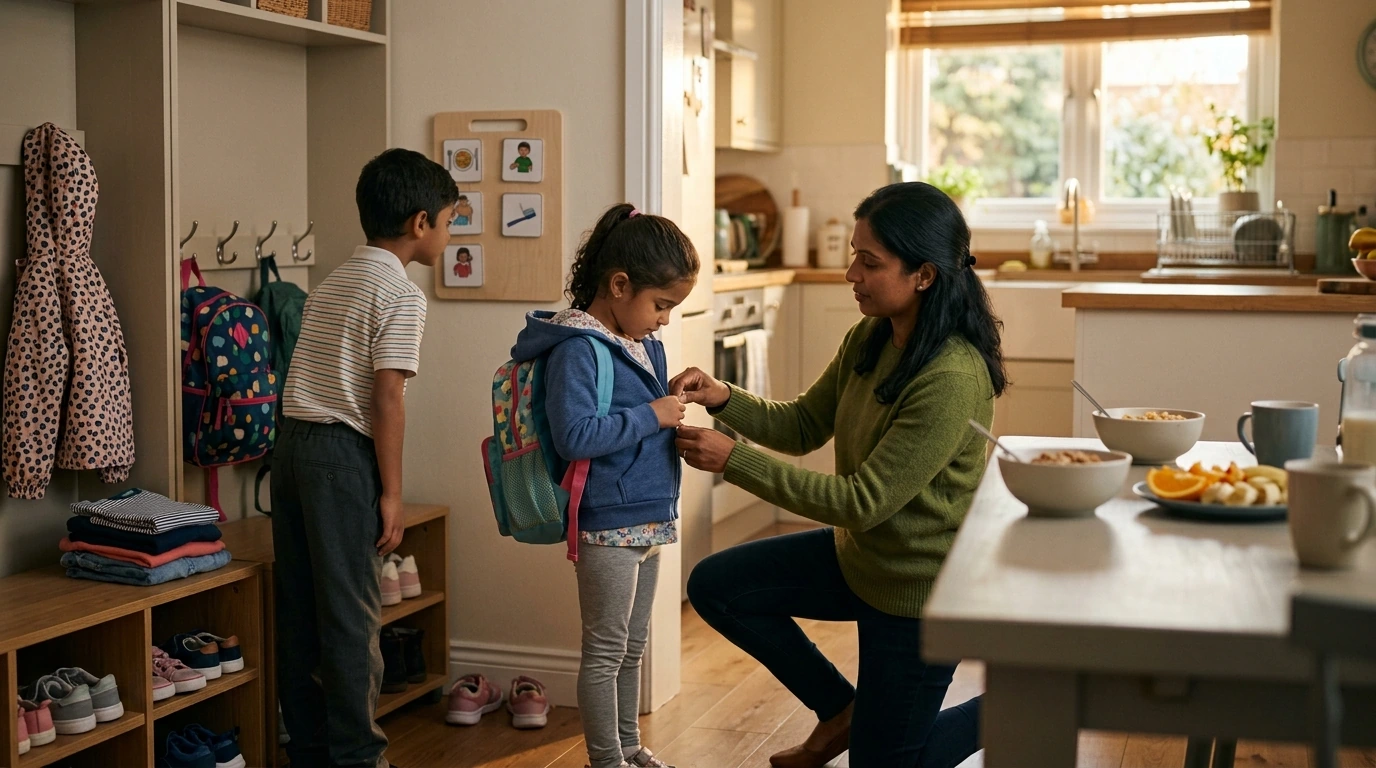
Calmer mornings usually come from fewer decisions, clearer expectations, and a routine that fits a child’s age and temperament. With a small amount of prep the night before and a predictable sequence in the morning, kids move through tasks with less prompting—helping everyone start the day feeling more regulated and on time.
Most “rough mornings” aren’t about motivation—they’re about friction. Transitions (bed to bathroom, pajamas to clothes), time pressure, hunger, missing items, and competing demands (siblings, devices, last-minute questions) can stack up fast. When kids don’t know what’s next, they’re more likely to stall, negotiate, or melt down.
A simple, consistent routine lowers uncertainty. Instead of deciding every step in real time (“Do I have to brush now?” “Can I play first?”), kids learn a sequence they can follow automatically. The key is making it visible, keeping it short, and practicing it on low-pressure days so it becomes familiar before it needs to work during a rush.
If mornings feel like a scavenger hunt, the cure is usually a 10-minute “evening reset.” The goal is to remove decisions and prevent the most common delays.
Sleep is a major predictor of morning mood and cooperation. The CDC’s sleep guidance and the American Academy of Pediatrics both emphasize consistent sleep routines for children—often the difference between “easy start” and “instant overwhelm.”
A routine works best when it’s realistic for your household and easy for kids to “run” on their own.
If power struggles flare up around choices, keep choices small and controlled. Research-backed parenting guidance often recommends limited options (two acceptable choices) to reduce conflict while preserving autonomy; Harvard Health also discusses how choices can help reduce power struggles (Harvard Health Publishing).
Use pictures and one-step prompts. Offer limited choices (“blue shirt or green shirt”) to prevent overwhelm. Expect support with time and transitions, not just tasks.
Add simple time awareness with a visual timer. Build independence one task at a time (for example, master dressing before adding “pack backpack”). Kids this age often do best with a clear “done list” they can check off.
Lean into autonomy and consequences. Use a shared calendar, a consistent launch pad, and a short “must-do” list before leaving. Keep lectures out of the morning; problem-solve later when everyone’s regulated.
| Time window | Preschool (3–5) | Elementary (6–10) | Tweens/Teens (11+) |
|---|---|---|---|
| 30 minutes | Bathroom + dress (with help) → simple breakfast → shoes/coat → out the door | Dress → bathroom → breakfast → teeth/hair → pack/launch pad → out the door | Wake → quick wash → dress → grab breakfast → final check (keys/ID) → out the door |
| 45 minutes | Wake + cuddle/connection (5 min) → bathroom → dress → breakfast → shoes/coat → leave | Wake → dress → bathroom → breakfast → teeth/hair → review backpack → leave | Wake → shower (if needed) → breakfast → pack/charge check → leave |
| 60 minutes | Wake → bathroom → dress → breakfast → play buffer (5–10 min) → leave | Wake → dress → breakfast → teeth/hair → chore/help task → buffer → leave | Wake → workout/stretch (optional) → breakfast → grooming → plan check → leave |
If you want a ready-to-use framework, the Stress-Free Morning Routines for Kids – Easy Morning Routines for Kids Guide is designed to help families build a predictable routine, set up the night before, and handle common derailments without turning every morning into a debate.
For families balancing busy school mornings with sports drop-offs and activities later in the day, Play Smart, Stay Safe: Your Outdoor Sports Safety Guide can be a helpful companion for planning smoother, safer activity days—especially when you’re already simplifying routines at home.
For many families, 30–60 minutes is realistic depending on age, sleep quality, and temperament. Add a 10-minute buffer to protect the routine from small delays, and keep the wake-up time consistent so the body clock can adapt.
Use one clear rule: screens come after essentials are finished (and keep the checklist visible). Create a morning “parking spot” for devices and follow through with consistent consequences when the rule is broken.
Do a quick audit: is sleep slipping, are there too many steps, or are expectations unclear? Return to the simplest version of the routine and change only one element at a time (wake time, breakfast plan, or exit sequence) until it stabilizes again.













Leave a comment